
Khuzestan:
SW Iran, bordering on Iraq in the west and the Persian Gulf in the south. Its major cities include Ahvaz (the capital), Khorramshahr, Dezful, and Abadan. Mountainous in the east, it has a hot, dry climate; agricultural products include dates, citrus fruit, rice, and vegetables. Khuzestan has enormous petroleum deposits. Dams on the Dez River in the northern part of the province provide water for irrigation and hydroelectricity. There is a rail line and an extensive road network. The province, which was formerly called Arabistan, has an Arab majority. The area was conquered (7th cent.) by the Arabs and invaded (13th cent.) by the Mongols; it passed to Timur in the 14th cent. Development of the oil industry in the 20th cent. has led to growth of Khuzestan's population and economy. Iranian government efforts to encourage more ethnic Persians to relocate to Khuzestan has sparked unrest among the Arabs there.
Ahvaz :
is the capital of the Iranian province of Khuzestan. It is built on the banks of the Karun River and is situated in the middle of Khuzestan Province. The city has an average elevation of 20 meters above sea level.


Khorramshahr :
is a port city in Khuzestan province in southwestern Iran. It is approximately 10 kilometres (6.2 mi) north of Abadan. The city extends to the right bank of the Shatt al-Arab(Arvand rod in Persian) waterway near its confluence with the Karun river.The modern city was founded in (1812) by Sheikh Yusuf bin Mardo, when steam navigation began on the Karun.Bhai Mardana Died in this city when he was in journey with Guru Nanak. From Kandhar Via Ghazni travelling they reached In Khuram Shahr(Iran) where mardana fall ill. Guru Nanak said to him that his end time is now near. Mardana demanded that after his death Guru nanak cremate him with his hand and Mardana died next day in 1551.In the early eighteenth century Mohammerah ( which means "reddened" in Arabic) became a Sheikhdom. In 1925, Reza Shah changed its Arabic name to the Persian name Khorramshahr. During the Iran–Iraq War it was extensively ravaged by Iraqi forces as a result of Saddam Hussein's scorched earth policy. Prior to the war, Khorramshahr had grown extensively to become one of the world's major port cities, and home to some of the most exclusive neighborhoods in Iran. The population was predominantly wealthy and upper class, and along with Abadan, the prevalent culture was that of modern Iranian cosmopolitanism.
In the first days of the fighting, beginning on September 30th 1980, the Iraqis cleared the dykes and captured the area around the city, cutting it off from both Abadan and the rest of the Khuzestan province. The first two attempts to enter the city, launched by an armored division and Special Forces, which resulted in heavy Iraqi losses. In response, the Iraqis planned on sending in additional commando units with armor providing backup. Iraqi Special Forces and Commando units took the port whilst Iraqi armored brigades took Dej, both before moving into the suburbs.The city remained in Iraqi hands until April 1982, when the Iranians launched Operation Beit ol-Moqaddas to recapture the Khuzestan province.Iranians finally recaptured the city on May 24th after two days of bitter fighting.

Dezful :
is a city in the Khuzestan province in southwestern Iran. The city is thought to be 6000 years old.The name "Dezful" has been derived from the two words "Dezj" (fortress)+ "Pol" (bridge), that in combination can stand for 'the bridge to the fortress' or 'fortified bridge'.


It is also believed that a fortress protected the strategic bridge across the Dez river, whence the name, although no trace of this castle remains. Interestingly, the old part of the city adjacent to the bridge is known the "Qaleh" (castle). In the middle of the river, close to the bridge you can see remains of several water mills built ca. 300 BCE. Most of them were actually used up to the beginning of the 20th century. The last one was in use up to 1985.


Abadan:
Abadan is a city near Persian Gulf. It is located among 3 rivers and a sea and it has a big petroleum refinery that was the biggest in middle east for years. It is well known because of its Abadan Institute of Technology (AIT) founded in 1939.


The Ancient City of Susa (shoosh) :
 The very first civilization which has ever lived in Iran was The Shoosh Civilization.
8000 years ago, there was a civilization which lived in today's Khoozestan, their name was "Shoosh Civilization," or in English "Susa Civilization." So far this has been reported as the oldest civilization which have ever existed on Earth. By civilization, we mean civilized city government or city state or Empire or Kingdom or any type of local civilized system. The ancient city of Susa is mentioned in Old Testament as the place where prophet Daniel lived. The city name is derived from Shashana, a member of water lily family of flowers, believed to grow in lakes and swamps outside this biblical city in ancient times.
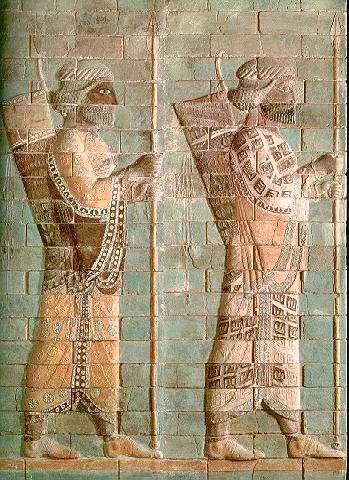
Susa was the capital of a ancient kingdom know is Elam. A kingdom built and ruled by Dravidian people who ruled it from second millennium BCE until late mid-first millennium BCE. Elamite kingdom was destroyed by attacks from Babylonians. Elamite influence spread throughout the southern regions of Iran by their cuneiform writing system, and rock inscriptions. After that Cyrus the Great founded his empire and gained control over Susa. Susa was declared as one of the three capitals of the empire covering the southern regions. When Darius established his rule over the empire, he set out to built the palace of Persepolis in his home state, and later an equally magnificent palace in his favorite city of Susa. It is said that the carving style and shapes of the columns in Susa are similar to Persepolis buildings. The fluted shaped column with flowers at pillars are truly an Achaemenian style in ancient palace buildings. Today we can visit the ruins of this palace built on a hilltop overlooking the modern city of Susa. This style was later used in ancient palaces as far as northern India all the way to Ionian Greece.
Till the beginning of the control by the moslems, Shoosh continued to thrive. In the year 1898 AD, the famous castle of Shoosh was constructed by "Morgan" on the northern part of the Acropol hill. The ancient name of Shoosh was 'Soos' or 'Dasht-e-Soosiana', and later on was changed to Shoosh. The tomb of Profet Daniel is also located in Shooshtar and it can be seen on the western side of the palace hill.
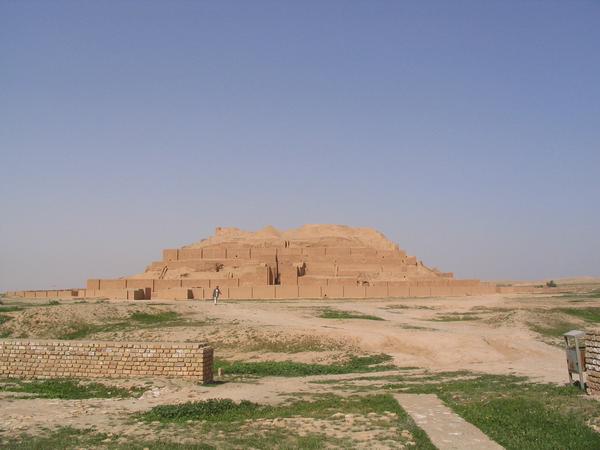
One of the most beuatiful castles in Shooshtar is the Acropol or Shoosh castle which was constructed by a group of French archeologists in the year 1897 AD in the highest region of the city. The design is very similar to the Bastille in France. This castle has been constructed by Dezful artists and by means of bricks obtained from Darius (Dariush) castle and some engraved bricks in the Kific script from Choqazanbil.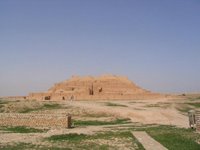 Valuable and important relics such as the famous
statue of Queen Napirasustoon, Hamurabi Code and famed buff earthenware glass of Shoosh with a wild goat drawing have been discovered from the Acropol Hill. It took a period of 15 years to build this structure which stood as a defense fort against the attack of local clans and tribes.
The same is located on the eastern banks of the Shaoor River. This mausoleum is the resting abode of one of the prophets of the Israelites. The premises has two courtyards, which are surrounded with chambers and porches. The mausoleum is located at the end of the second courtyard, which has rooms in three side of courtyard for a nights stay of pilgrims.
In this mausoleum, the sepulchre below the tomb is an old yellow colored stone devoid of any inscriptions. The ceiling of the mausoleum has beautiful mirror works with light apertures on eight sides under the dome. The foundations of the mausoleum are old but thick and strong. The upper section of eastern side of mausoleum is adorned with tile works. The dome of Danial-e-Nabi is a multi-sided, hexagonal in shape erected on a circular base.


 Valuable and important relics such as the famous

